

BLUEBERRIES OR BUST
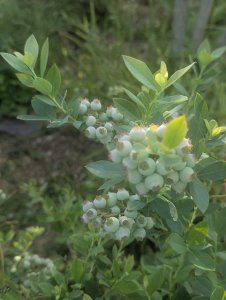
Blueberries have so many virtues. The North American native shrubs are attractive enough to stand on their own as garden ornamentals. The sweet fruits are tasty eaten out of hand and amenable to culinary applications from appetizers to shortcakes. And while you are eating those beautiful blue fruits, you are also getting helpful amounts of vitamins C and K, as well as antioxidants. What’s not to love? What’s not to grow? The only hard part is choosing the blueberry type and variety, and that may depend at least partly on where you live. Armed with a little knowledge, you can be singing the blues (berries) as early as this summer.
Northern Blues
If you live in USDA zones 3-7, you can choose from varieties of Northern Highbush blueberries (Vaccinium corymbosum), shrubs that grow high, wide and handsome, reaching five to nine feet tall, with some newer varieties remaining more compact. The shrubs produce large, sweet berries. Popular varieties include ‘Earliblue’, which, true to its name, fruits in June ahead of the July peak production season. Dating back to 1916, the ‘Jersey’ blueberry bears fruit later—generally in late July or August.
Southern Sweetness
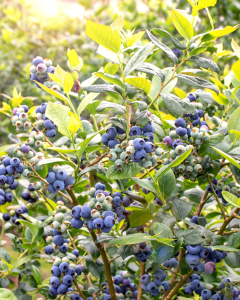
Southerners can opt for either the hybrid Southern Highbush (Vaccinium corymbosum x Vaccinium darrowii) or the aptly named Rabbiteye (Vaccinium ashei). Hardy in USDA plant hardiness zones 5-10 and needing relatively few hours of cold winter weather to set fruit, Southern Highbush blueberries may grow between six and eight feet tall. Breeding programs have produced many varieties, some of which are better for the commercial market, while others
thrive in home garden settings. ‘Jewel’ produces large fruit in the middle of the summer blueberry season, while ‘Magnus’ is an early fruiting variety with large berries.
Rabbiteye blueberries are large at six to 15 feet, with a spreading habit. Native to the American southeast, they are the most heat and drought tolerant of all the blueberries The evocative name comes from the pinky color of the unripe berries, which inspired comparisons to the eyes of albino rabbits. Varieties include ‘Climax’, with early-ripening, large fruits and ‘Titan’, known for producing large fruit at mid-season.
Wild and Tasty
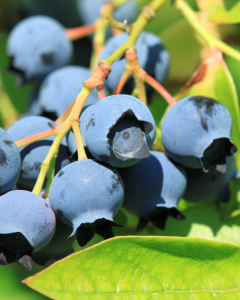
Lowbush blueberries (Vaccinium angustifolium) creep along the ground in their native areas of the northern United States and Canada (USDA zones 2-6). These are the true “wild” blueberries—with small, extremely sweet fruit. Breeders crossed the cold tolerant lowbush blueberry with the northern highbush type to produce the Half-High blueberry bush, which thrives in USDA zones 3-7. These hybrids feature larger berries than the lowbush types and excellent cold tolerance. Look for plants with northerly names like ‘Polaris’ and ‘Northland’.
Ornamental Edibles
Blueberries are delicious and worth growing even if you never really look at the plants. However, the shrubs have considerable ornamental value. Starting in spring, the bushes bear the pinkish-white, bell-shaped flowers that are characteristic of other plants in the Ericaceae family, like pieris and heathers. After commanding the full attention of early spring pollinators, the flowers give way to the developing fruits. By fall, the leaves turn a brilliant red, making the shrubs stand out among other stars of the autumn garden. Because blueberries offer three seasons of interest, some gardeners even use them en masse as flowering/fruiting hedges.
Good Things in Small Packages
Plant breeders are very attuned to the needs of small-space gardeners, whether those spaces are patios, driveways, or containers. If you fit that category, you too can have your fill of the blue fruits.
At 24 inches tall and 20 inches wide, little ‘Top Hat’ is a cross between the Northern Highbush blueberry and the lowbush blueberry. With a mounding habit, it is perfect for a medium to large container and will produce large fruits. Another intriguing small hybrid variety is ‘Pink Lemonade’, which has rosy pink fruits with exceptionally an exceptionally sweet blueberry taste. It is hardy in USDA Zones 4-8 and can grow up to four feet tall, perfect for a large container.
Get Growing
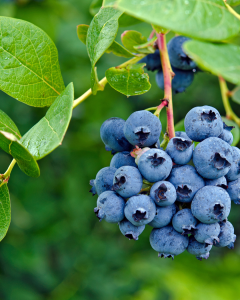
Blueberries overall are undemanding plants but prefer well-drained soil on the acid side of the pH scale. For good soil chemistry, amend the planting soil with an organic product like Fafard® Premium Natural and Organic Compost. Most types are self-fertile, meaning that the shrubs will produce fruit without another compatible blueberry bush nearby. However, to increase fruiting, buy a second, compatible blueberry. Rabbit eye varieties are the exception to the self-fertile rule and will not set fruit without a companion plant. If you plan to purchase one, make sure to check with the vendor about which compatible varieties are available.
Regular moisture is a must, especially when young shrubs are establishing their root systems, and sunshine is essential.
Get a Net
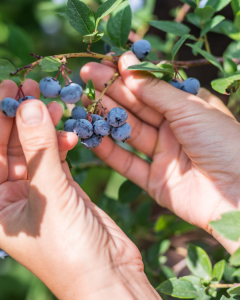
One last thing to consider…If you want to enjoy the fruits of your labors, consider investing in some fine mesh netting to cover your blueberries when the fruit begins to ripen. In my garden the birds eyeball the blueberry bush from the time it begins to flower, waiting impatiently for the fruit. Without netting they would eat it all.
Of course, attracting birds to the garden is a distinct benefit even if they devour every last blue morsel. In that situation, it pays to remember that a blueberry bush is worth having for its ornamental value alone.
