
Articles

Barking up a Tree: Tree Bark that Shines in Winter by Elisabeth Ginsburg

When you look at trees during the growing season, you see leaves and sometimes flowers or fruit.  Winter offers a different perspective.  With the leaves absent, many deciduous trees offer a lovely extra—interesting bark that provides a fourth season of interest.  It is something to think about when you are creating or adding to a landscape.

Taking a Shine

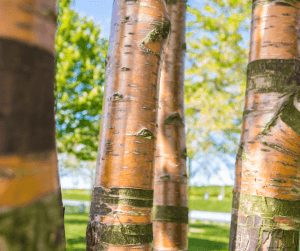
Birchbark cherry (Prunus serrula), also sometimes known as “redbark cherry,” is a small ornamental tree (20 to 30 feet tall and wide) that is rightly celebrated for its ethereal white spring blossoms.  Those blooms are followed during the growing season by slender, toothed leaves. In winter, the trees become Cinderellas, undergoing a seasonal exfoliation, or shedding of the old outer bark layer.  The young bark underneath is lustrous enough to appear polished and reddish brown like mahogany.

Birchbark cherry enjoys the same conditions as other ornamental cherry trees, preferring full sun to light shade and well-drained soil.

Snakes Alive

Snakebark maple (Acer pennsylvanicum) is a North American native tree that goes by many common names, including whistlewood, striped maple, goosefoot maple and moosewood.  The young bark is unique in its green and white vertical stripes, which in an earlier time reminded some people of snakeskin.  Perfect for smaller gardens, snakebark maple grows 15 to 25 feet tall, with a nearly equal spread, and can also be grown as a large shrub.  Like many maples, the snakebark variety features lobed leaves, with each leaf sporting a trio of lobes.  This probably gave rise to the “goosefoot” nickname.  Yellow fall foliage makes snakebark maple a year-round attraction in partly shaded conditions with consistent moisture.

Thinking Pink

Japanese maples (Acer palmatum) are widely loved for their landscape versatility, offering sculptural shapes, deeply dissected leaves, and attractive fall colors.  The ‘Sango-kaku’ or coralbark variety adds another dimension to Japanese maple allure, with winter bark that is pale pink to rosy red on young branches and stems.  Growing 20 to 25 feet tall and slightly less wide, the trees are remarkably tolerant of heavy soil and can even survive in proximity of toxic black walnut trees. Small clusters of red-purple flowers appear in spring, followed by leaves with five or seven slender lobes apiece.  As a prelude to that rosy winter show of bark, the leaves turn shades of yellow and reddish bronze in the fall, prior to their winter departure.

Like many Japanese maples, the coralbark variety is an understory tree, happiest in dappled shade.

Exfoliation Station

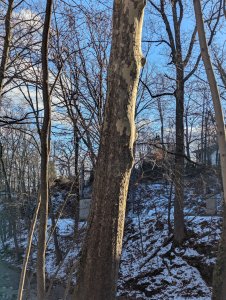
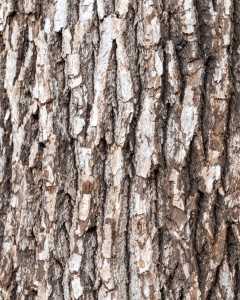
The American sycamore is a majestic tree, sometimes growing as large as 75 to 100 feet tall and wide—perfect for parks and other large spaces.  In earlier generations, when urban and suburban streets were narrower, and the spaces between sidewalks and streets were wider, sycamores were also sometimes used as street trees. Known botanically as Platanus occidentalis, sycamores are another species with a high tolerance for a variety of soil conditions, as well as urban and suburban pollution.  In the summer, these statuesque beauties boast large, lobed leaves.  The brown bark of the sycamore exfoliates in patches to reveal stark white bark underneath.  This feature gives the trees a distinctive camouflage-like appearance, making them recognizable even from a distance.  Older trees, with an abundance of white bark, look almost ghostly on foggy or rainy days.

Sometimes sycamores are called “buttonwood” or “buttonball” trees because their fruiting structures are clusters of seeds that when ripe leave the trees as down-covered tufts.  Preferring full sun, sycamores can also tolerate light shade.

A Camellia-Like Chamaeleon

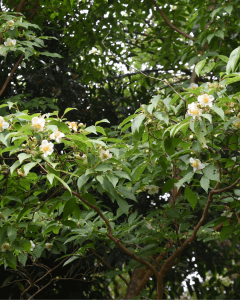
Japanese stewartia (Stewartia pseudocamellia) is a member of the tea family, with features reminiscent of its relative, the true camellia.  Growing 20 to 40 feet tall and 15 to 30 feet wide, the trees can be kept to reasonable size with pruning after flowering.  A true four-season plant, Japanese stewartia covers itself with white, camellia-like flowers in late summer, at a time when most flowering trees have finished the floral floorshow.  The flowers are made more distinctive by the prominent golden orange anthers in the center of each one.  Fall finds the trees coloring up with leaves turning shades of orange, red, and gold.  Once the leaves are gone, it is easy to see the distinctive bark.  Like the sycamore, stewartia exfoliates, revealing multi-colored patches of young bark that may be pale gray or brown, peachy-taupe or a tawnier orange-brown shade.  It is camouflage, but extremely interesting camouflage.

Stewartia is another understory tree, thriving in partial shade.  It demands consistent moisture, but the rewards are stunning year-round.

Covered in all the Papers

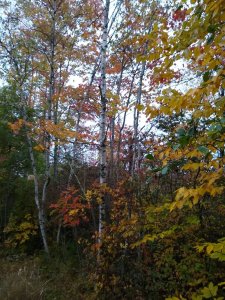
North American native paper birch or Betula papyrifera, is a shade and moisture-loving tree that thrives in cooler climates.  Used by Native Americans to fashion birchbark canoes, the trees can grow 50 to 75 feet tall, with a width of 25 to 50 feet, but often do not reach those dimensions in suburban landscapes.  Showy male and female catkins appear on the trees in spring, and the female catkins eventually give way to cone-like fruiting structures.  Paper birches may develop into specimens with a single trunk, or several slightly thinner ones.  The most distinctive feature of any paper birch is the stark white bark, which peels away from the trees in curling, papery strips revealing tawny brown underbark.  The bark on older birches may show dark horizontal striations as well.

Plant to Last

Planting trees with interesting winter bark is a good landscape investment.  To get the best return on that investment, choose the right site and make sure that you consider the tree’s mature size before it goes into the ground.  Amend the soil in the planting hole with a good compost mix, like Fafard® Premium Natural and Organic Compost, and mulch, donut-fashion around the base of the new tree.  Water regularly until the roots become established, as well as later in times when there is little rain.  Add the peeled bark fragments from exfoliating species to the mulch to save on clean-up.

About Elisabeth Ginsburg

Born into a gardening family, Elisabeth Ginsburg grew her first plants as a young child. Her hands-on experiences range from container gardening on a Missouri balcony to mixed borders in the New Jersey suburbs and vacation gardening in Central New York State. She has studied horticulture at the New York Botanical Garden and elsewhere and has also written about gardens, landscape history and ecology for years in traditional and online publications including The New York Times Sunday “Cuttings” column, the Times Regional Weeklies, Horticulture, Garden Design, Flower & Garden, The Christian Science Monitor and many others. Her “Gardener’s Apprentice” weekly column appears in papers belonging to the Worrall chain of suburban northern and central New Jersey weekly newspapers and online at http://www.gardenersapprentice.com. She and her feline “garden supervisors” live in northern New Jersey.


What Perennials and Shrubs To Plant in Fall

Summer perennials and potted shrubs are great to plant in fall!

“Perennials (both woody and herbaceous) are shifting energy from their tops to their roots, preparing for their fall underground growth spurt.” -Russell Stafford

Gardeners tend to do the bulk of their planting and planning in spring when the horticultural hormones are running high. For many plants and purposes, however, fall is the perfect time to get down to some serious gardening. The best time, in fact.

Fall Growing Conditions

Fall growing conditions tend to be cool and moist–just perfect for new plantings.

Consider the conditions in fall. Soil and air temperatures are typically moderate, beneficial underground microflora are active, and soils retain moisture longer (thanks to the cooler air and lengthening nights). Plants, too, are undergoing favorable changes. Perennials (both woody and herbaceous) are shifting energy from their tops to their roots, preparing for their fall underground growth spurt. Deciduous plants are shedding their leaves, removing their main source of water loss and drought stress. On all fronts, things are geared for root growth, for as long as soil temperatures remain conducive (above around 40 degrees F).

Plant a hardy tree, shrub, or herbaceous perennial now, and its roots will proliferate (as conditions allow) until spring, gathering energy and preparing for a prosperous new year. Compared to an equivalent plant installed next spring, it will have a far more extensive root system, already adapted to the conditions on (and in) the ground. It will grow faster, tolerate drought better, and in almost every other way out-perform its spring-planted kin.

Bulbs for Fall

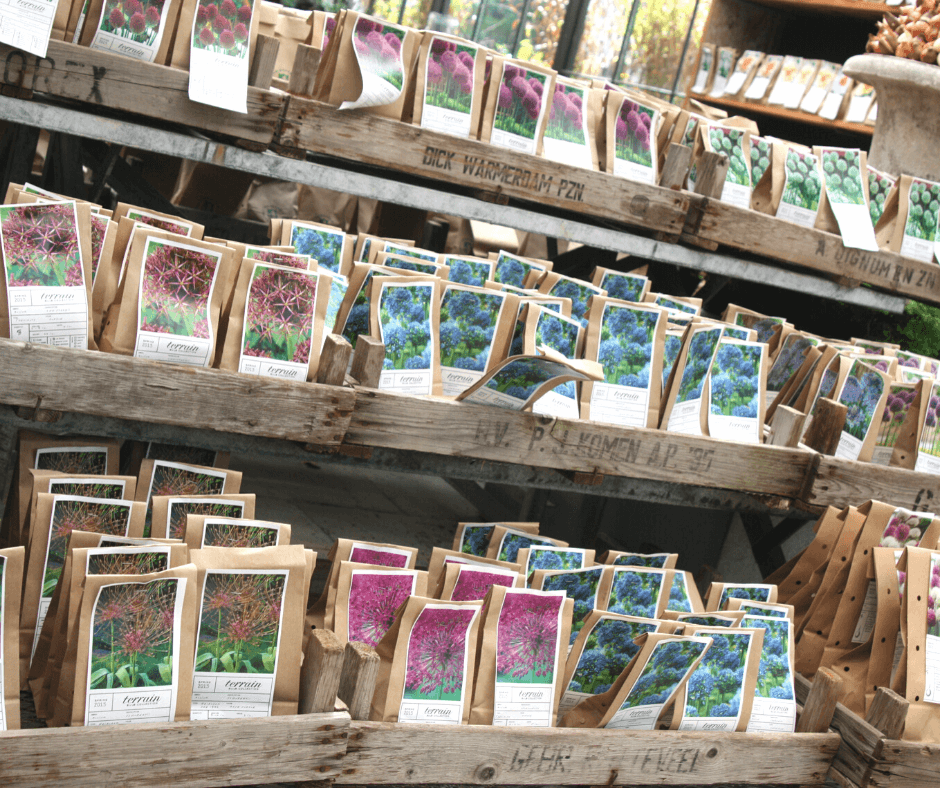
Hardy spring bulbs must be planted in fall. (Image by Jessie Keith)

Bulbs (including the rhizomes, corms, etc. that go under this term) are a special case. Most hardy spring-blooming bulbs absolutely require at least a couple of months in chilly, moist soil to stimulate rooting and develop and extend their flower buds. These are the bulbs for fall planting–crocus, daffodils, tulips, and hyacinths are among them. Don’t worry about planting them late, especially if you find bags of bulbs on sale in late October. Bulb planting into late November is just fine as long as you can work the soil. Adding a quality bulb fertilizer at planting time will help them flourish.

On the other hand, some bulbs spend winter in a rootless quiescent state and take well to winter dry-storage and spring planting. Many of the latter are frost-tender things such as dahlias, but the winter-dormant group also includes some hardy “bulbs” such as roscoeas and crocosmias.

Plants You Should Plant in Spring

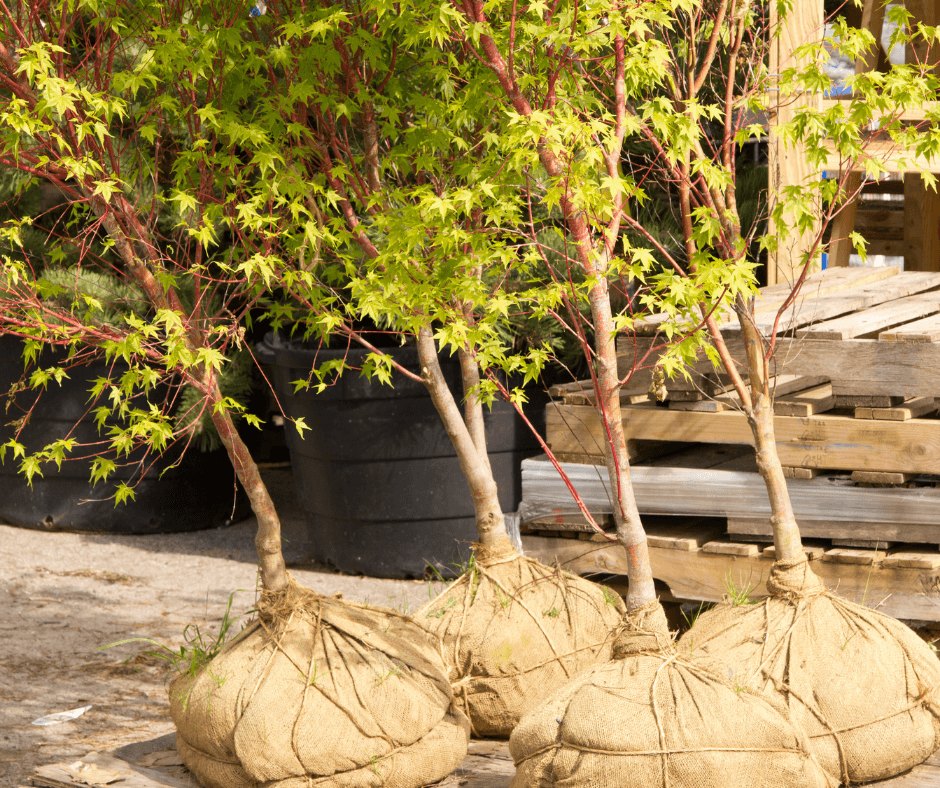
Balled and burlapped shrubs and small trees should be planted in the spring, not fall.

As with all things horticultural, a few provisos apply. Most of the above advantages are nullified in the case of bare-root or balled and burlapped (B&B) plants, which lose many of their roots during harvesting. With their reduced underground resources, they may lack the capacity to replace water lost from stems and leaves during cold windy weather. Fall-planted bare-root and B&B evergreens are especially prone to winter damage. Severely root-bound container-grown plants do relatively poorly with fall planting, for the same reasons. In contrast, container-grown plants have relatively extensive root systems, buffering them against winter weather.

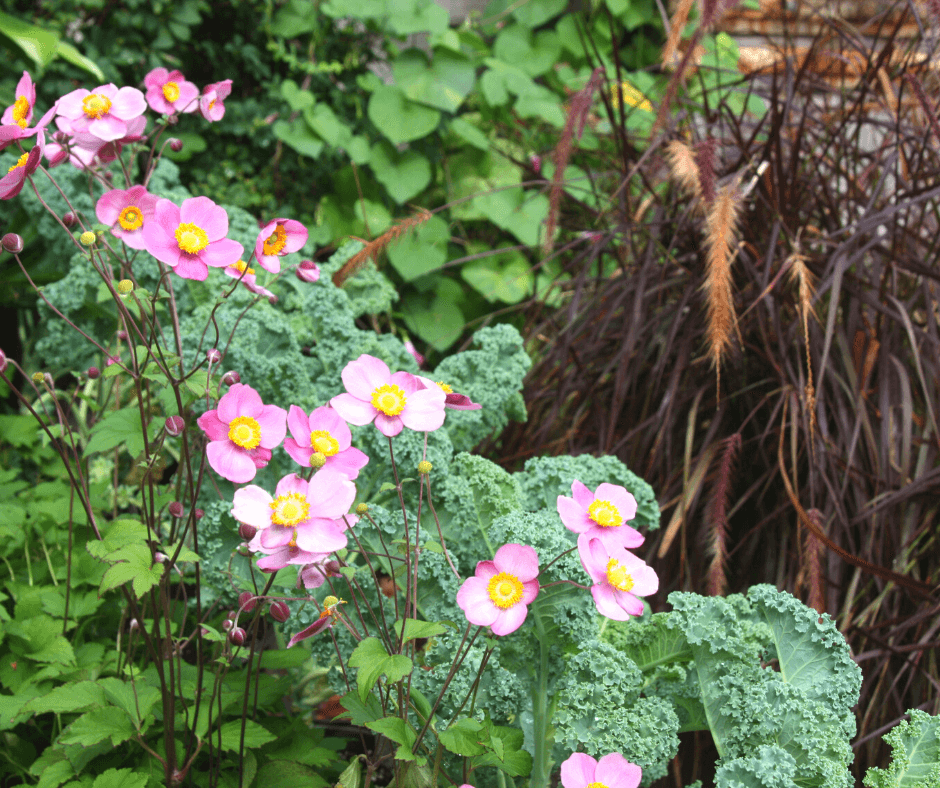
Fall perennials, like Japanese anemones, prefer springtime planting. (Image by Jessie Keith)

Additionally, some plants that hit their prime in summer and autumn tend to languish if planted in fall, whatever the condition of their roots. Many warm-season grasses and fall-blooming perennials, for example, prefer spring planting. Marginally cold-hardy plants may also benefit from spring planting, which gives them more time to establish before heading into their first winter. Small perennials and shrubs in little pots may also need the headstart of spring planting to grow and set ample roots by fall.

Fall Planting Tips

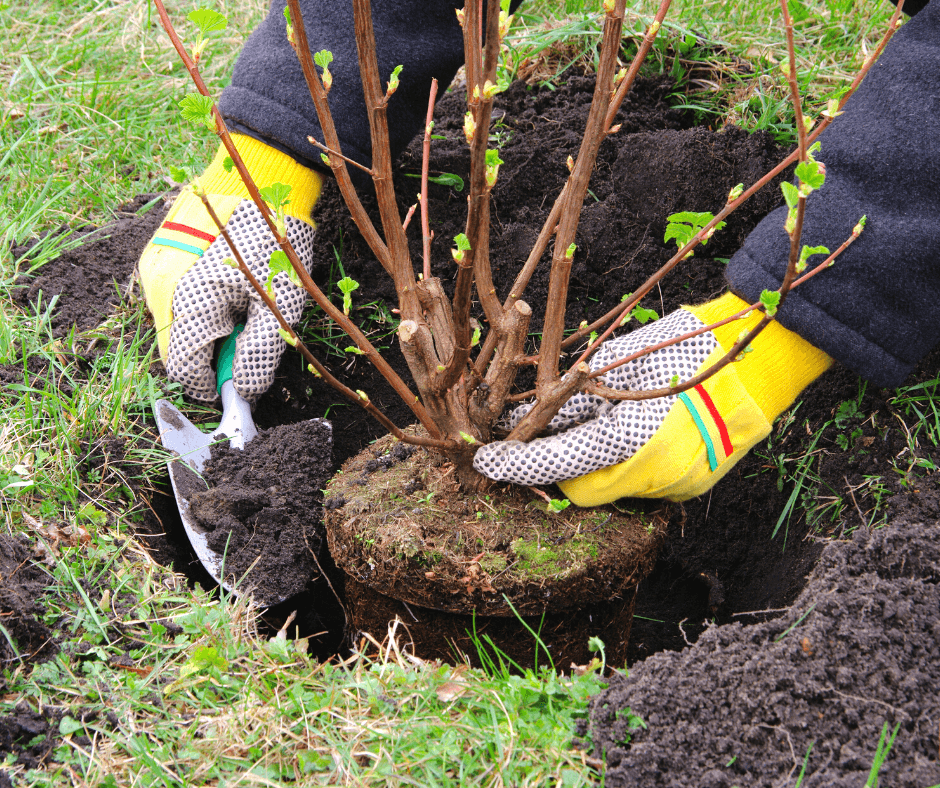
Make sure that potted plants do not have any congested or girdled roots as this will limit fall root growth.

Planting at least 6 weeks before your last frost date will give perennials and shrubs plenty of time to set new roots (click here to determine your last frost date). Whatever you plant this fall, be sure to provide the conditions for optimal rooting. Dig a planting hole as deep and several times as wide as the root ball. If the soil is excessively heavy or sandy, dig an even wider hole, and generously amend the backfill with Fafard® Premium Topsoil. Tease the surface of the root ball to loosen any congested or girdling roots. After planting and watering your new prize, apply a layer of compost topped with two or three inches of a porous mulch such as oak leaves, pine needles, or shredded bark. This will blanket the roots from drought and cold, extending their season of growth. Come spring, you’ll have a well-rooted plant, ready for takeoff.

*Fall is also an ideal time to divide and plant summer perennials! (Click here to learn more about perennial division.)