

KOREAN SPICE VIBURNUM
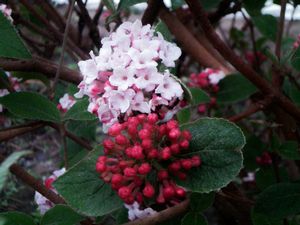
A Star in Spring
In spring sweet fragrance is everywhere—wafting softly from daffodils and issuing assertively from hyacinths. The great spring fragrance drama peaks with lilacs, but even before that, Korean spice viburnum (Viburnum carlesii) steps up with an absolutely intoxicating aroma.
Growing between four and six feet tall and wide at maturity, this useful deciduous shrub is part of the large viburnum genus, which is home to about 150 species. Many of them are great garden plants, but, as English botanist Martin Rix says in The Botanical Garden, “the spring-flowering Viburnum carlesii and its hybrids are among the best-scented of all shrubs.”
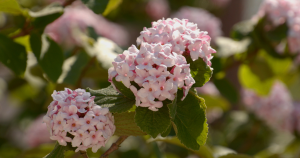
Fragrant Globes
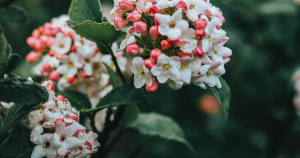
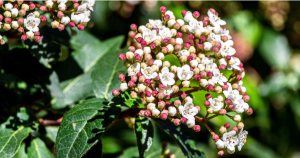
All that fragrance happens in late March or early April, depending on location and climate conditions. Small globes (three inches wide) composed of scores of rose-pink buds appear first, and if you sniff them, your nose will register just a hint of the sweetness to come. The buds open into round, white flowerheads composed of scores of individual blooms. The flowerheads look like small snowballs and exude strong perfume, especially when the sun is shining, and temperatures are warm. As with hyacinths, the fragrance is strong enough that a single “snowball” in a vase will scent a small room.
Once the flowering show is over, the shrub assumes its pleasant supporting role in the garden, sporting large green, toothed leaves. Eventually red drupes or berries form, changing to black as they age. In the fall, the leaves turn red before leaving the scene for winter.
The main reason to buy a Korean spice viburnum is the spring scent–but it is reason enough.
A Victorian Favorite
Viburnum carlesii was named for an Englishman, William Carles, a member of the British Consular Service and amateur plant collector in the late nineteenth century. Maggie Campbell Culver, in her wonderful book, The Origin of Plants, mentions that Carles collected plants in Korea in 1883-1885, which is when he must have obtained the plant that was named in his honor. The species was first described by English botanist William Botting Hemsley, who had a long career at the Royal Botanic Garden at Kew, ending up as Keeper of the Herbarium and Library
Anything that smells as good as this viburnum was bound to catch on fast. By 1907, Viburnum carlesii was so popular that its portrait appeared in the well-respected Curtis’s Botanical Magazine. If it had not made its way to the United States by that time, it was soon to do so. A 1947 edition of the Wayside Gardens catalog refers to the shrub as “a great favorite.”
Spicy Choices
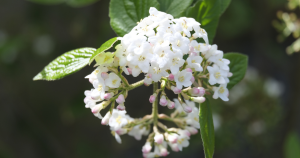
If you are looking for a Korean spice viburnum, the list of choices is large. All offer the fragrant spring flower globes and many boast good fall color. Varieties like ‘Sugar-n-Spice’ and ‘Spice Girl’ grow six to seven feet tall and almost equally wide. For something a bit smaller and more compact, try ‘Spice Baby’, which tops out at three to five feet tall, or ‘Spice Island’, which has a mounding habit and grows to four or five feet. Little ‘Compactum’ is smaller still at three to four feet tall and wide. While most Korean spice viburnums are hardy in USDA Zones 5-8, ‘Spice Island’ is more heat tolerant and hardy through Zone 9.
For larger gardens, ‘Mohawk’, a hybrid cross between Viburnum carlesii and Viburnum burkwoodii, offers the addition of glossy foliage and good fall color on bushes that grow six to eight feet tall. Another hybrid, ‘Cayuga’, can soar to 10 feet.
The smaller varieties will grow successfully in containers, provided that the pots are at least 24 inches in diameter with excellent drainage.
An Easy Grower
The old Wayside catalog’s cultural information is still good today: “Hardy, easily grown and does well in light shade, as well as in full sun.” When planning a planting site, be sure to factor in the mature height and width of the specific viburnum variety. Plant in spring or fall in well-drained soil amended with a high-quality product like Fafard ® Garden Manure Blend. Water regularly to get the shrub established. Once the plants have set roots they are relatively drought tolerant.
If your shrub needs to be pruning to shape, do so after it blooms.
Pollinators’ Delight
It is no surprise the Korean spice viburnum attracts butterflies and other pollinating insects as readily as it attracts human admirers. The black fruits will feed birds and small animals in the fall and early winter. The shrubs can be used as hedges, or as the focal points of pollinator gardens. Containerized specimens can also anchor large-scale container arrays.
After a long winter, most of us are tired of indoor odors like wet wool or damp dog. Korean spice viburnum is the perfect olfactory refresher.

About Elisabeth Ginsburg