

NEWS FROM THE WORLD OF HELLEBORES
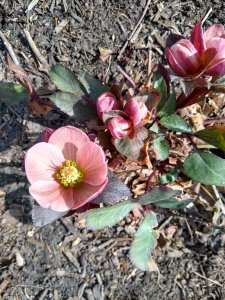
What did gardeners ever do without hellebores, those beacons of the late winter and early spring garden that are happy in light shade, mostly impervious to deer, and offer lovely, long-lasting flowers? Fortunately, none of us have to worry about that since breeders and merchandisers are turning out new varieties every season. The hardest part now is choosing the right ones for your location.
So, what’s new under the hellebore sun? Plenty. Even if you are a hellebore fanatic, it’s highly likely that you will run out of space before you run out of hellebores.
Uncommon Commonality—Helleborus orientalis
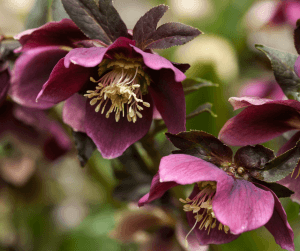
Hellebores are low-growing members of the buttercup or Ranunculaceae family. A number of species are commercially available, but the most popular by far is generally sold as Helleborus orientalis or Lenton Rose. That species originated in Turkey and the Caucasus regions, growing about 18 inches tall and wide, with large, palmate leaves and nodding flowers in shades ranging from white through pink-purple to true purple. In time the orientalis species was crossbred with a number of other hellebores to produce Helleborus x hybridus, which dominates the market today.
Because of that popularity, breeders all over the world have worked to improve hellebores, extending the color range, creating bigger, more outward-facing flowers, and showy double blooms. Every growing season brings new developments in the world of hellebores.
All that Glitters is Gold
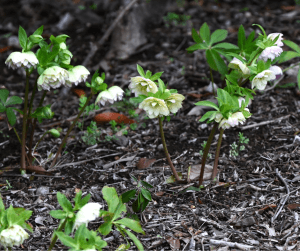
One of the brightest developments in hellebore breeding is gold-flowered varieties, which were developed from crosses involving green-flowered Helleborus viridis and other species.
‘Searchlight’ bears single yellow petals in a shade of greenish yellow, while showy double-flowered varieties like ‘Golden Lotus’, shine in pale gold. Gold also figures strongly in bicolors like the double-flowered ‘Sun Flare’, which is part of the Winter Jewels® series of hellebores. ‘Sun Flare’ features medium yellow petals accented by red edges. ‘Sunshine Ruffles’ features a similar double configuration with yellow petals. The red edges are much narrower than those of ‘Sun Flare’.
Double the Fun
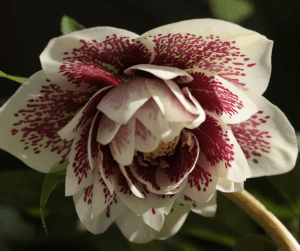
And speaking of doubles, the current hellebore passion for double flowers is reminiscent of the Oscar Wilde quote, “Nothing exceeds like excess.” ‘Midnight Ruffles’, which is ‘Sunshine Ruffles’ opposite number, arrays itself in large black blooms with a multitude of petals. The only hint of brightness is at the center of each flower, where golden stamens hold court. ‘Painted Jewels,’ another entry in the Winter Jewels® line, boasts white petals “painted” with dark red splotches. ‘Wedding Crasher’ is spectacular with a double number of pale pink petals liberally dotted with darker red.
The double-flowered hellebores, which bloom at the same times as their single-flowered counterparts do not seem any less vigorous and certainly make a splash at a time when most flowers have not even made an entrance.
Facing Up to It
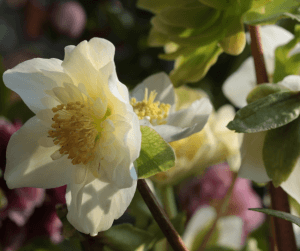
One of the holy grails in hellebore breeding has long been upward facing flowers. The downward or nodding posture of many hellebore species’ flowers was an adaptation that protected the flowers’ reproductive organs from frosts. However, even the most resolute hellebore admirers do not like getting down on all fours to appreciate the flowers. Most of the Helleborus x hybridus varieties and strains still nod in the spring breezes, but some of their
relatives, bred from a combination of species, sometimes including Helleborus niger, the “Christmas rose,” have blooms that if not upward-facing, at least turn outward towards the viewer. German hybrids, like ‘HGC® Diva’ couple white flowers, sometimes with a pinkish or greenish tinge with the outward-facing trait. For something in a darker shade, ‘HGC® Merlot’, with red wine-colored flowers and dark stems, fills the bill.
Foliage Interest
While hellebores put on a big show in the spring, some gardeners look for plants with added interest. Hellebore breeders have come up with varieties with variegated foliage, like ‘Ivory Prince’, which is known botanically as Helleborus x nigerericsmithii and toothed leaves veined in white, in addition to its ivory flowers. HGC ‘Pink Frost’ features similar leaves and dusty pink blooms. Since variegation is popular, look for more variegated-leaf plants in the future.
Hellebore Care
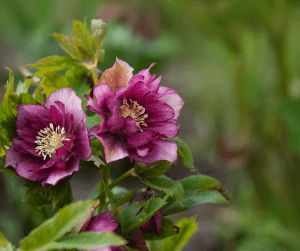
Whether your hellebore has yellow flowers, upward-facing blooms or variegated leaves, it needs good care to thrive. Plant in a sunny or lightly shaded location with rich soil. Amend that soil at planting time with a high-quality amendment, like Fafard® Premium Natural and Organic Compost, and water young plants regularly. Hellebores are seldom troubled by critters and, if happy, will increase in size. Be warned, a young plant may only have a few flowers in the first year but will hit its stride in years two and three.
Some self-seeding may also happen, and if you are trying to fill a large area, this may be a welcome event. However, since named varieties are produced from hand-pollinated and carefully selected parent plants, the seedlings in your garden will most likely not have the same traits as the parents.
