

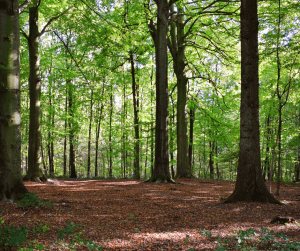
When you look at trees during the growing season, you see leaves and sometimes flowers or fruit. Winter offers a different perspective. With the leaves absent, many deciduous trees offer a lovely extra—interesting bark that provides a fourth season of interest. It is something to think about when you are creating or adding to a landscape.
Taking a Shine
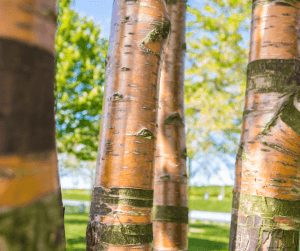
Birchbark cherry (Prunus serrula), also sometimes known as “redbark cherry,” is a small ornamental tree (20 to 30 feet tall and wide) that is rightly celebrated for its ethereal white spring blossoms. Those blooms are followed during the growing season by slender, toothed leaves. In winter, the trees become Cinderellas, undergoing a seasonal exfoliation, or shedding of the old outer bark layer. The young bark underneath is lustrous enough to appear polished and reddish brown like mahogany.
Birchbark cherry enjoys the same conditions as other ornamental cherry trees, preferring full sun to light shade and well-drained soil.
Snakes Alive
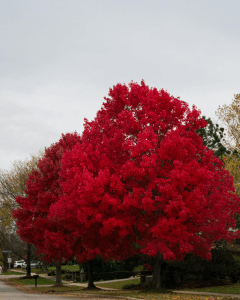
Snakebark maple (Acer pennsylvanicum) is a North American native tree that goes by many common names, including whistlewood, striped maple, goosefoot maple and moosewood. The young bark is unique in its green and white vertical stripes, which in an earlier time reminded some people of snakeskin. Perfect for smaller gardens, snakebark maple grows 15 to 25 feet tall, with a nearly equal spread, and can also be grown as a large shrub. Like many maples, the snakebark variety features lobed leaves, with each leaf sporting a trio of lobes. This probably gave rise to the “goosefoot” nickname. Yellow fall foliage makes snakebark maple a year-round attraction in partly shaded conditions with consistent moisture.
Thinking Pink
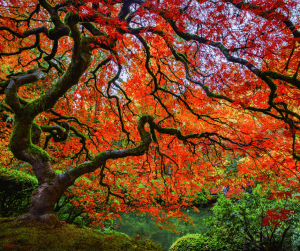
Japanese maples (Acer palmatum) are widely loved for their landscape versatility, offering sculptural shapes, deeply dissected leaves, and attractive fall colors. The ‘Sango-kaku’ or coralbark variety adds another dimension to Japanese maple allure, with winter bark that is pale pink to rosy red on young branches and stems. Growing 20 to 25 feet tall and slightly less wide, the trees are remarkably tolerant of heavy soil and can even survive in proximity of toxic black walnut trees. Small clusters of red-purple flowers appear in spring, followed by leaves with five or seven slender lobes apiece. As a prelude to that rosy winter show of bark, the leaves turn shades of yellow and reddish bronze in the fall, prior to their winter departure.
Like many Japanese maples, the coralbark variety is an understory tree, happiest in dappled shade.
Exfoliation Station
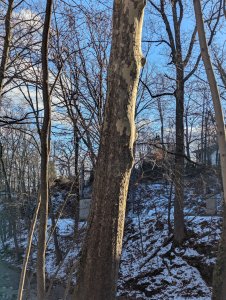
The American sycamore is a majestic tree, sometimes growing as large as 75 to 100 feet tall and wide—perfect for parks and other large spaces. In earlier generations, when urban and suburban streets were narrower, and the spaces between sidewalks and streets were wider, sycamores were also sometimes used as street trees. Known botanically as Platanus occidentalis, sycamores are another species with a high tolerance for a variety of soil conditions, as well as urban and suburban pollution. In the summer, these statuesque beauties boast large, lobed leaves. The brown bark of the sycamore exfoliates in patches to reveal stark white bark underneath. This feature gives the trees a distinctive camouflage-like appearance, making them recognizable even from a distance. Older trees, with an abundance of white bark, look almost ghostly on foggy or rainy days.
Sometimes sycamores are called “buttonwood” or “buttonball” trees because their fruiting structures are clusters of seeds that when ripe leave the trees as down-covered tufts. Preferring full sun, sycamores can also tolerate light shade.
A Camellia-Like Chamaeleon
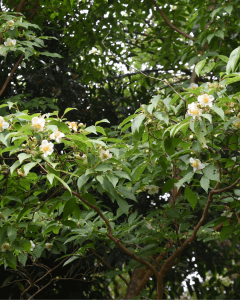
Japanese stewartia (Stewartia pseudocamellia) is a member of the tea family, with features reminiscent of its relative, the true camellia. Growing 20 to 40 feet tall and 15 to 30 feet wide, the trees can be kept to reasonable size with pruning after flowering. A true four-season plant, Japanese stewartia covers itself with white, camellia-like flowers in late summer, at a time when most flowering trees have finished the floral floorshow. The flowers are made more distinctive by the prominent golden orange anthers in the center of each one. Fall finds the trees coloring up with leaves turning shades of orange, red, and gold. Once the leaves are gone, it is easy to see the distinctive bark. Like the sycamore, stewartia exfoliates, revealing multi-colored patches of young bark that may be pale gray or brown, peachy-taupe or a tawnier orange-brown shade. It is camouflage, but extremely interesting camouflage.
Stewartia is another understory tree, thriving in partial shade. It demands consistent moisture, but the rewards are stunning year-round.
Covered in all the Papers
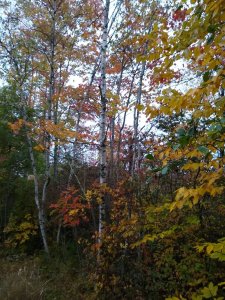
North American native paper birch or Betula papyrifera, is a shade and moisture-loving tree that thrives in cooler climates. Used by Native Americans to fashion birchbark canoes, the trees can grow 50 to 75 feet tall, with a width of 25 to 50 feet, but often do not reach those dimensions in suburban landscapes. Showy male and female catkins appear on the trees in spring, and the female catkins eventually give way to cone-like fruiting structures. Paper birches may develop into specimens with a single trunk, or several slightly thinner ones. The most distinctive feature of any paper birch is the stark white bark, which peels away from the trees in curling, papery strips revealing tawny brown underbark. The bark on older birches may show dark horizontal striations as well.
Plant to Last
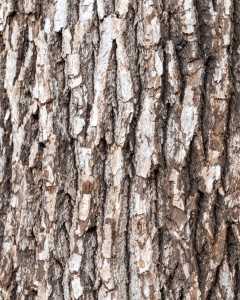
Planting trees with interesting winter bark is a good landscape investment. To get the best return on that investment, choose the right site and make sure that you consider the tree’s mature size before it goes into the ground. Amend the soil in the planting hole with a good compost mix, like Fafard® Premium Natural and Organic Compost, and mulch, donut-fashion around the base of the new tree. Water regularly until the roots become established, as well as later in times when there is little rain. Add the peeled bark fragments from exfoliating species to the mulch to save on clean-up.

About Elisabeth Ginsburg